“I am absolutely convinced that there is, overall, far too little rather than enough or too much cognitive monitoring in this world. This is true for adults as well as for children, but it is especially true for children.”
Flavell, 1979
This nine-part series of articles is the result of more than 10 years of on-and-off research and an unquantifiable amount of obsession, experimentation and invention within the realm of metacognition and its application to private piano instruction. Each article will publish 1 week apart.
The parts will consist of:
- Defining the Problem (this article)
- Quantifying Practice Quality
- PIT Practicing
- Goal Types
- Goal Interactions
- Reflection
- Independence vs. Modeling
- The One-to-Three Rule
- MetaPractice
Metacognition (“thinking about thinking”) can be understood in terms of both skill and knowledge. Metacognitive skill can be thought of as a never-ending three-part cycle consisting of planning, monitoring and evaluation:
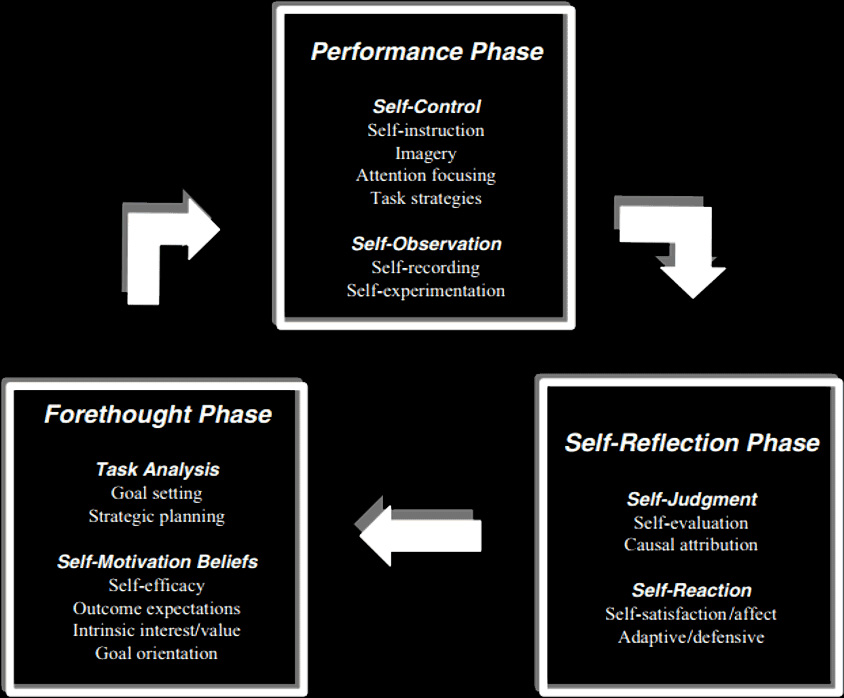
In the self-translated words of Jurgen Baumert, self-regulated learning is “a dynamic interaction of ‘skill and will.'”
Metacognitive knowledge consists of knowledge that informs metacognitive skill. All of the following examples could be considered cognitive knowledge, just like any other knowledge, but when they are used in service of informing practice strategy, they become metacognitive:
- Self: “I struggle with memorizing.”
- Environment: “The keys on my piano at home are really easy to push down compared to most other pianos.”
- Subject matter: “It’s generally harder to fix a wrong rhythm than it is to fix a wrong note.”
Metacognition has been found to play a greater role in learning than mere cognition alone (Veenman, et al, 2006). In the context of musical study, practice strategy has been found to make a bigger difference in performance quality than how much or how long one practices (Duke, Simmons & Cash, 2009). As Louise Goss aptly put it, “Practice is not a matter of time spent, but a matter of mind spent.”
Flavell, the scholar who ignited interest in metacognition in the ’80s by coining the term and offering an insightful breakdown of it, spoke of a concern that still rings true today:
“I am absolutely convinced that there is, overall, far too little rather than enough or too much cognitive monitoring in this world. This is true for adults as well as for children, but it is especially true for children.”
(Flavell, 1979)
Pitts, et al (2000) echo this concern through observation, applied more specifically to music practicing:
“…the majority [of children practicing] display few self-correction techniques, and play through their pieces or exercises with little discernable self-evaluation.”
“…we witnessed [in students’ practice routines] a great deal of time-wasting and avoidance…”
Pitts & Davidson (2000)
While teachers universally acknowledge the great need for students to develop metacognitive skill, very few teachers know how to specifically go about accomplishing this goal (Wilson & Bai, 2010). Veenman and others reach the same conclusion:
“When we interviewed teachers about metacognition, their incidental responses did not go beyond ‘independent learning…,’ while a further query about how they applied metacognition in their lessons only resulted in blanks (Veenman, Kok & Kuilenburg, 2001; but see also Zohar, 1999). Teachers are absolutely willing to invest effort in the instruction of metacognition within their lessons, but they need the tools for implementing metacognition as an integral part of their lessons, and for making students aware of their metacognitive activities and the utility of those activities.”
Veenman, et al (2006)
Teachers are universally interested in doing more to develop their students’ metacognitive skills. Which students stand to benefit the most? Cheng found that metacognition and giftedness come as a pair:
“Several psychologists take a strong position on the relationship between metacognition and giftedness. Central to this position is the view that the gifted individual is an active and efficient information-processor and problem-solver.”
Cheng (1993)
Similarly, Alexander (2006) finds that metacognition is unsurprisingly correlated positively with high IQ (cognition), and that improving metacognition makes the biggest difference in helping students with lower IQs. Zohar, et al. (2008) similarly found that “meta-strategic knowledge” has a strong effect on low-achieving students. This is compounded by self-efficacy, as Nielsen (2004) found that students with high self-efficacy in musical practice are more likely to be cognitively and metacognitively involved in trying to learn the music compared to those who doubt their abilities.
What all this means is that students with average or below average musical predisposition (who very often correlate with students with average or below average self-efficacy) stand to benefit the most from deliberate effort to develop metacognitive skill.
Complexity of Music
“If there is broad agreement that providing good models is an effective strategy for learning, then why are there so few available models of effective practice?”
(Duke, Simmons & Cash, 2009)
While there is a substantial amount of research into metacognition in the classroom environment, comparatively little research has been carried out exploring metacognition in the environment of private instruction, especially in musical instruction. And yet the need for research seems inverted: while students’ scholastic pursuits are purely academic in nature, musical pursuits involve developing not only academic knowledge of music, but also physical coordination and synchronization of sound in time, both of which introduce magnitudes more possibility of error during practice than when engaged in purely academic pursuits.
Additionally, even the mere academic element of developing musical competency is a considerably complex human endeavor, especially with regard to learning to play piano, because those learning to read sheet music must read both horizontally for the passage of time, as well as vertically for the movement of both hands, with organists covering even more vertical space on the page to read instructions for their left foot. The fact that there is so much more room for error to occur during musical practice would suggest that there is an even greater need to develop metacognitive skill in the context of private music lessons than there is in the classroom environment.
This great need is reinforced on a personal level by private music teachers on a daily basis when their students show up to lessons each week with so few of their assigned goals completed. For a majority of teachers (with possible exception to teachers in renowned institutes, music professors, and other teachers with access to select, competitive students), many students will show up to lessons with half or less of their goals done, and this seems acceptable to most of the students and their parents even though similar effort in their academic pursuits would be considered mediocre at best and failure at worst.
Love Of Music: The Double-Edged Sword
Love of music is responsible for both involvement and failure in musical study.
Twedt’s Paradox of Musical Study
Love of music causes a student to beg for music lessons and sit down each day and joyfully play their instrument. Unfortunately, it is this same love of music that also causes students to play music (pleasure-seek) even when they should be practicing (working) instead. Most students will take a fast tempo while trying to fix a mistake, even when the fast tempo prevents the mistake from being detected, simply because it is more enjoyable to take a fast tempo.
Brundage (2016) describes this problem as a problem of being in “stage 3” mode while attempting to practice goals when one should be in stage 1 or 2, according to a three-stage learning model of motor skill:
- Cognitive stage – more cognitive engagement than physical effort (“more thinking than doing”)
- Associative stage – less concepts/procedures, more concentration on physical movement
- Autonomous stage – little or no cognitive engagement (“more doing than thinking”)

Practicing while in “stage 3” mode creates a fluency illusion in which familiarity is mistaken for correctness. As a student often thinks, “If it’s easy, it must be correct.”
Many students will also fail to isolate mistakes, starting in the beginning of the piece, playing all the way through the piece, even when told to fix a wrong note in one small spot. At best, this results in more elapsed time between repetitions when trying to fix the goal, and at worst, it results in no repetition.
Both of these common examples (playing too fast, and playing from the beginning/not isolating) demonstrate monumental metacognitive failure while practicing: there is no planning/strategizing, there is little (if any) monitoring for error (and the monitoring is marginally effective because of the fast tempo and/or failure to isolate problems), and later evaluating the success of the practicing is difficult or impossible for the same reason. The end result is the ignoring of mistakes. This would be analogous to trying to study for a biology test by speed reading 15 pages of notes from beginning to end over and over again. The biology notes would eventually be learned by this method, but at an abysmally slower pace and with more errors than if small sections of the biology notes are carefully studied one section at a time, including drilling and self-quizzing.
If this “speed read all the way through from the beginning” technique of study is lunacy, then the vast majority of music students (young and old) would be, by that definition, lunatics. Even the best private teacher has difficulty helping the average student develop metacognitive skill in the daily practice routine without actually being at the student’s side every day during practice, which is why:
“…the teaching of practise skills and strategies is an important part of the instrumental teacher’s role, allowing learning to become independent and therefore sustainable beyond the confines of the weekly lesson.”
Pitts & Davidson (2000)
Even despite our great diligence, so many students pleasure-seek at home even when shown how to properly practice during the lesson:
“…children’s awareness of desirable practise strategies is not always carried through into their own work.”
Pitts & Davidson (2000)

In fact, counterintuitively, as the average student’s musical skill increases, there is no improvement on organization of practice, analytic approach, or level of concentration (Hallam, et al., 2012). Additionally, even though the most advanced students tend to practice more efficiently, there is a dip in the use of effective practice strategies in the middle years of study, starting at around grade 3. I believe these metacognitive stagnation and dipping effects are enabled or compounded by two factors: piece level and at-home accountability.
First, pieces at the beginning level are shorter than more advanced pieces, so even when a beginning student pleasure-seeks and plays their entire 12- or 16-measure piece over and over again, the student may still derive great benefit from practicing since the music is short enough to produce relatively short time intervals between repetitions. The habits of this kind of practicing continue into the next levels as intermediate students underestimate the need to isolate and drill when it is so critical that they transition into more effective practice strategies. And unlike intermediate students, advanced students (if they make it that far) simply cannot progress at all without finding more ways to practice efficiently, so only out of dire necessity, they finally practice small sections of music, practice more slowly, monitor more closely for errors, etc.
Second, since so many students practice unsupervised, they are denied the environment they need to develop metacognitive skill:
“…for many learning activities, particularly academic tasks, teachers are usually present to give feedback on the accuracy or success of a child’s performance.”
Pitts & Davidson (2000)
A student may very well know that the best way to fix a wrong fingering is to isolate a small spot in the music and “drill” it until it is habituated (i.e. the teacher has given the student the correct metacognitive knowledge), but the student continues to pleasure-seek anyway instead of practicing (i.e. the student does not exercise metacognitive skill). Stephanie E. Christensen found in a case study (2010) that a gap exists between the students’ metacognitive knowledge and their application of effective practice strategies. As a student gains musical skill over the course of years of lessons, the gap between musical and metacognitive skill can even widen due to musical skill increasing at a more rapid pace than metacognitive skill, even sometimes despite the most skilled teacher’s best efforts in providing in-lesson hands-on instruction on efficient practice strategies.
The blessing and curse of loving music doesn’t end there. This metacognitive gap is not helped by a false assumption among students and some parents that since music is so enjoyable to listen to or sing along with, it must also be enjoyable to study at all times. This makes some parents more reluctant to “make” their child practice out of fear that it will strip their child of the joy of music making. Some parents seek traditional musical instruction for their child with the expectation that their children quickly gain musical skill and become competent musicians while simultaneously expecting music to be a recreational escape from the disciplines of the day. In reality, it takes as much or more work to develop musical skill as it takes to develop skill in any other discipline. In that regard, some parents sign their children up for failure from the first day of lessons because they hold unreasonable expectations for the music practicing experience, unless they specifically seek lessons from an RMM teacher. [“Recreational Music Making,” much like in the field of music therapy, focuses on the enjoyment of the musical experience rather than pace of musical progress.] In truth, when done right, traditional musical study may very well be the most mentally vigorous of all the day’s activities. Ironically, it is typically the students who approach their musical study with vigor and discipline who enjoy musical study the most, because the highest musical joy and excitement comes from making rapid and consistent musical progress.
That said, optics matter. While it’s important for parents and teachers to be mentally prepared for the fact that music is a vigorous study that cannot experience genuine success without disciplined study, there is no reason to advertise it that way to the new, excited student who is first starting lessons:
“Treating practise as something that is ‘good for you’ … is an attitude unwittingly perpetuated by teachers and parents, and one which fails to connect with children’s intrinsic motivation…
…
…Hallam cites achievement, reward and social motivation as being powerful forces in supporting a child’s interest and developing sustainable intrinsic motivation.”
Pitts & Davidson (2000)
Additionally, it is more difficult to receive negative feedback from a teacher when the instruction is one-on-one, which is by far the most common setting for music lessons (rightfully so, since there is so much that can go wrong with practicing). The previously-mentioned love so many students have for music, which typically exceeds the love students have for any academic subjects they study in school, can cause a greater attachment of ego to the musical pursuit, which increases the need for delicacy when giving criticism to certain students.
Giving negative feedback to students in a way that does not damage students’ self-efficacy is further complicated by the fact that so much time elapses between each lesson. This effectively raises the stakes. Unlike school work, which is evaluated on a daily basis, every music lesson (and therefore every word of negative feedback) is judging an entire week of work. Certain students of all ages and genders, especially adults, have a difficult time hearing various types and degrees of negative feedback, no matter how warranted it is or how diplomatically it is delivered. Consequently, many teachers will water down the truth or downplay its importance so that the student is not disheartened, because sometimes disheartened students quit.
It is also interesting to note that as far as metacognition is concerned, age and wisdom are not correlated. Krätzig & Arbuthnott (2009) found that while both kids and adults tended to gain metacognitive skill as they gained item-specific experience (e.g., gaining experience studying piano naturally leads to the development of some metacognitive skill in piano with time), a more general “lifetime experience” had no effect on metacognitive skill. This implies a beginning adult student is in equally dire need of metacognitive instruction as young students. Unfortunately, while younger adults showed significant improvement in metacognitive skill with item-specific experience, older adults did not, reinforcing the cliché that one cannot teach old dogs new tricks.
Truth vs. Self-Efficacy
Because of the bad habits this pleasure-seeking creates and the pressure teachers feel to “walk on egg shells” to avoid harming student self-efficacy and motivation, music instructors face the difficult choice of (a) being honest about the gravity of a student’s practicing failures week after week, which may deflate and therefore demotivate the student and/or parent, or (b) downplaying the failed practicing routine, which can give the student a false sense of accomplishment and reinforce bad practicing habits.
In light of false perceptions that parents have for musical study and identities entangled with musical pursuits, only the most confident teachers are willing to lean toward option (a), risking student and/or parent demotivation by conveying failure to the student and/or parent whenever it is truly needed. That is, while a typical music student may very well be told to fix the same problem week after week, the student is never given any sort of score, grade, or any other tangible form of critical feedback that allows the student to discern the difference between great success, average progress, or utter failure in their overall weekly practice routine. And yet:
…feedback is more strongly and consistently related to achievement than any other teaching behaviour…this relationship is consistent regardless of grade, socioeconomic status, race, or school setting.
(Bellon, et al, 1992)
This presents an issue that should be of the very biggest concern within the field of private music pedagogy: despite the fact that musical study places greater demands on a student than most or all other pursuits, students are typically given insufficiently concrete feedback on the quality of their practicing and are therefore at a disadvantage in developing metacognitive skill. While general musical feedback (e.g., pointing out a student’s mistakes during a lesson) enables a mindful student to alter failed practice strategies, unfortunately, the average student will not be as mindful as needed if the feedback received is not delivered in a way that makes it matter. As Zimmerman and Campillo (2003) state, “Problem-solving skills mean little if a person is not motivated to use them.”
The issue of feedback (making it clear and making it matter) will lead directly into part 2 of this article series, Quantifying Practice Quality. But after detailing all of this metacognitive doom and gloom, I’d like to end with perhaps the single most effective thing we can do to address all of these problems: be direct with students and parents. Let them know when the issue at hand doesn’t just involve learning music, but learning how to learn music:
“Metacognitive strategy instruction that combines instruction on how to use particular strategies with an emphasis on the conditional knowledge of when and why to employ such strategies has long been considered the key to regulating one’s learning (Baker and Brown, 1984).”
(Huff & Nietfeld, 2009)
“Seminars on metacognitive strategies and the integration of music knowledge should become part of the music school curriculum.”
(Aiello, 2014)
Group performance classes would be the perfect place to start with a quick 5-minute discussion on metacognition. For example, “On the whiteboard is a goal. Take two minutes to think about the most effective way to practice that goal, and why. After the two minutes is up, we’ll share answers and discuss.” This is extremely engaging for students in any group setting, regardless of the mix of age or level.
Now that the various metacognitive problems that students have are documented, the remaining eight articles will focus on solutions to these problems, most of which will be extremely useful to share with students, and some of which are more for internal decision-making on the part of the teacher.
(c) 2022 Read Twedt
References
Aiello, Rita. “The Importance of Metacognition Research in Music.” Proceedings of the 5th Triennial ESCOM Conference (2003): 656-658. Electronic Publishing Osnabruck Music. Web, 13 Oct. 2014.
Alexander, Joyce M., Kathy E. Johnson, Jennifer Albano, Thea Freygang, and Brianna Scott. “Relations between intelligence and the development of metaconceptual knowledge.” Metacognition and Learning 1.1 (2006): 51-67.
Baumert, Jürgen. “lernstrategien, motivationale orientierung und selbstwirksamkeitsüberzeugungen im kontext schulischen lernens.” Unterrichtswissenschaft 21.4 (1993): 327-354.
Bellon, Jerry J., Elner C. Bellon, and Mary Ann Blank. “Teaching from a research knowledge base.” NASSP Bulletin 76.547 (1992): 121-122.
Brundage, Steven. “Fooled by Fluency: Understanding Illusions and Misjudgments in Music Learning.” American Music Teacher (Oct/Nov 2016): 10-13.
Cheng, Pui-wan. “Metacognition and giftedness: The state of the relationship.” Gifted Child Quarterly 37.3 (1993): 105-112.
Christensen, Stephanie E. “Practicing strategically: The difference between knowledge and action in two eighth-grade students’ independent instrumental practice.” Update: Applications of Research in Music Education 29.1 (2010): 22-32.
Duke, Robert A., Amy L. Simmons, and Carla Davis Cash. “It’s not how much; it’s how: Characteristics of practice behavior and retention of performance skills.” Journal of Research in Music Education 56.4 (2009): 310-321.
Fitts, Paul M., and Michael I. Posner. “Human performance.” (1967).
Hallam, Susan, et al. “The development of practising strategies in young people.” Psychology of Music 40.5 (2012): 652-680.
Krätzig, Gregory P., and Katherine D. Arbuthnott. “Metacognitive learning: the effect of item-specific experience and age on metamemory calibration and planning.” Metacognition and Learning 4.2 (2009): 125-144.
Nielsen, Siw. “Strategies and self-efficacy beliefs in instrumental and vocal individual practice: a study of students in higher music education.” Psychology of Music 32.4 (2004): 418-431.
Pitts, Stephanie, and Jane Davidson. “Developing effective practise strategies: case studies of three young instrumentalists.” Music Education Research 2.1 (2000): 45-56.
Veenman, Marcel VJ, Bernadette HAM Van Hout-Wolters, and Peter Afflerbach. “Metacognition and learning: Conceptual and methodological considerations.” Metacognition and learning 1.1 (2006): 3-14.
Wilson, Nance S., and Haiyan Bai. “The relationships and impact of teachers’ metacognitive knowledge and pedagogical understandings of metacognition.” Metacognition and learning 5.3 (2010): 269-288.
Zimmerman, Barry J., and Magda Campillo. “Motivating self-regulated problem solvers.” The psychology of problem solving (2003): 233-262.
Zohar, Anat, and Adi Ben David. “Explicit teaching of meta-strategic knowledge in authentic classroom situations.” Metacognition and Learning 3.1 (2008): 59-82.