“A man cannot search either for what he knows or for what he does not know. He cannot search for what he knows: since he knows it, there is no need to search; nor can he search for what he does not know, for he does not know what to look for.“
Plato
Part of the reason reflection (discussed in the previous article) is so important is because it makes the student part of the goal-assigning process, which is far more effective than being corrected directly by the teacher. While reflection with the teacher may not be 100% pure, unguided self-correction, it is certainly closer than if the teacher just plainly describes the problem and prescribes the solution. In a way, it turns the teacher into a diplomat according to Daniele Varè’s definition: “Diplomacy is the art of letting other people have your way.” Robert Duke (2012) succinctly points out that “Learning is error correction,” so of course whether the error correction is self-imposed or comes from a teacher doesn’t matter as much as simply making sure the correction (i.e. learning) takes place. But keeping this “diplomacy” in mind, the most elegant, artful teaching would cause students to feel as if assigned goals every week were their own idea. Even more effective is when pride comes before the fall:
“A person pays more attention to the correction of an error he makes when he committed the error under high confidence, and this added attention leads to better memory of the correction.”
Butterfield & Metcalfe, 2006
Self-error-correction, especially in its purest form (independent, unguided by a teacher) motivates a brain to commit an experience to memory far better than when errors are corrected by teachers. Duke elaborates that memory resulting from self-directed error correction will always be more persistent, understandable, and generalizable than memory from a correction directly from the teacher. But not every teacher capitalizes on this. Duke writes that well-meaning teachers:
“…correct their [students’] errors efficiently, consistently, and ultimately, unfortunately, in ways that limited their [students’] own cognitive involvement (and cognitive effort). Not good. Not enough (self-directed) error correction.
Aiello (2003) agrees, saying that the model of teaching that involves a lot of teacher modeling and student imitation:
“…does not foster a dialogue between the teacher and the student. It does not encourage the student to ask questions. … Such an imitation model does not necessarily foster metacognitive abilities.”
“Teachers should explicitly help their students develop their metacognitive capacities…”
All of this points back to the Pedagogy 101 fundamental that the primary goal of a teacher should be to teach themselves out of their job, or in the words of Jain (2014), when reflecting on Louise Goss’s legacy (emphasis added):
“Goss’s primary goal as a teacher was to develop students’ minds so they grow to be independent learners, making the teacher expendable.”
Holland (2014) also remembers Louise Goss in a similar way:
“After reviewing their teaching during the past year and listing what they should do differently based on what they learned from Louise Goss, one graduate student wrote, ‘I will begin to judge my success as a teacher by what my students can do on their own without any help from me.’”
This principle is not new, nor is it owned by western culture. As the Chinese proverb says, “Give a man a fish, and you feed him for a day. Teach a man to fish, and you feed him for a lifetime.” I believe most or all teachers have seen various examples of “fish handouts” in the world of music teaching. The most common example I’ve witnessed is nearly every year when various college faculty colleagues (in multiple states – I believe this happens everywhere) talk about one or two freshman students with dazzling technique who “don’t understand anything they’re doing.” This is the result of the kind of teaching that uses modeling so much that it hampers music literacy and leaves little room for students to develop independence from the teacher. One faculty member describes this as “Try-it-this-way-dear” teaching.
But before we get too righteous about this, we must stop and remember that modeling holds a critically important place in music instruction. Knowing the precise place it should have in teaching from student to student, piece to piece, and goal to goal can be one of the most difficult balancing jobs a music instructor has. It presents an always-present independence vs. modeling dilemma since self-error-correction is impossible without intention. In other words, before practicing a spot in the music, the student must have in their mind some kind of analytical/audio/visual/kinesthetic “answer key.” Without this answer key (or “intention”) in mind before they practice the spot, the student’s ability to detect an error, no matter how slow they go, is limited or impossible, depending on the student and the goal.
Meno’s Paradox (Plato) outlines this dilemma perfectly:
“A man cannot search either for what he knows or for what he does not know. He cannot search for what he knows: since he knows it, there is no need to search; nor can he search for what he does not know, for he does not know what to look for.“
We should note that Plato’s idea of “not knowing” here is quite rigid, because it is certainly possible to “know that we don’t know something.” But Plato is not talking about this kind of ignorance; he is talking about the cold absence of information or any clues that would point to it. Interestingly, Schwartz (2006) argues that the feeling of not knowing something is a metacognitive state, not a cognitive one (i.e., the feeling of not knowing something, rather than the cold absence of information), although I would argue it is both.
But regardless of such philosophical distinctions, Plato’s point is well-taken by music teachers who know all too well that there are some goals and skills that a student cannot complete / acquire without modeling from the teacher, while there are also some metacognitive skills a student cannot develop if modeling robs them of the opportunity. Teachers must achieve a very careful balance between developing independence and modeling. How specifically is this done?
Five Stages of Metacognitive Development
First, it is helpful to think of five theoretical stages of metacognitive development in musical study. Some disclaimers first:
- These stages assume the student is given sufficient guidance over the years by their teacher to develop metacognitively, or the student is exceptional in their ability to develop their own metacognition. What follows does not represent the typical student if left to their own. As you might recall from the first article of this series, there are metacognitive stagnation and dipping effects as students progress in their studies (Hallam, 2012).
- All of the following skills develop in parallel to each other, but for the most part, they are mastered in the order of the stages.
- It is unimportant whether these stages are defined in this exact way or that we memorize which stage implies which skill. What is important is the general concept conveyed by this table, which will be highly useful later on.
| Stage | Follows Instructions | Detects Errors | Fixes errors | Avoids Errors | Interprets |
|---|---|---|---|---|---|
| 1 | YES | no | no | no | no |
| 2 | YES | YES | no | no | no |
| 3 | YES | YES | YES | no | no |
| 4 | YES | YES | YES | YES | no |
| 5 | YES | YES | YES | YES | YES |
A stage 1 student can only be relied upon to follow their teacher’s instructions on their own, and even this can be unreliable, depending on the student’s age/development (a 5-year-old needs the help of parents just to even follow directions). In stage 2, a student gets better at detecting errors on their own. Fixing of errors also improves, although smart strategies in fixing errors are not necessarily employed. Smart error-fixing strategies are more often employed in stage 3. In stage 4, a student draws on years of experience of “being burned” by careless strategies in learning new material, so the student exercises more metacognitive caution to avoid making errors in the first place. Stage 5 represents a large jump from stage 4. Not only are errors avoided (all marks in the music are observed), the student even tries to fully interpret what is not written in the music. (Said differently, while the stage 4 student tries to avoid receiving error correction goals from their teacher, the stage 5 student tries to avoid receiving any goals from their teacher.)
How these stages actually map to levels of advancement might be more accurately estimated by this table:
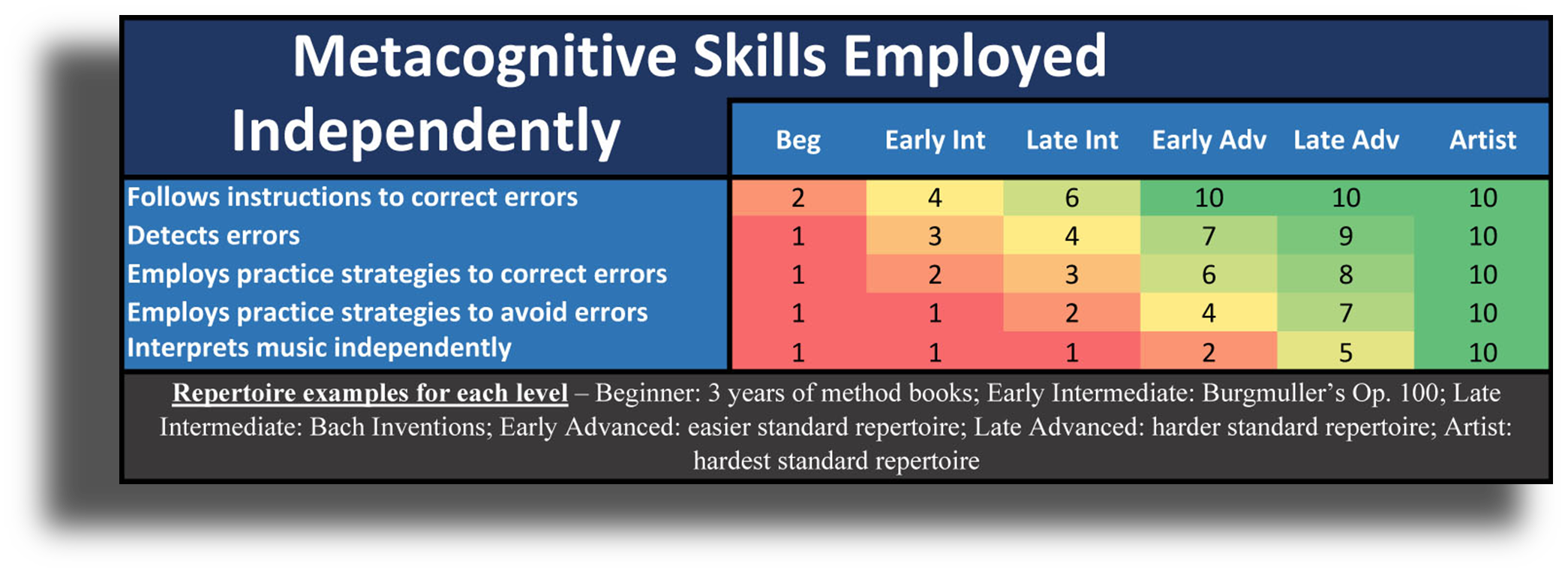
To elaborate a bit on the “Artist” level, metacognitive skills are now intuitive, and lesson plans at this level may be controlled more by the student than by the teacher (i.e., “What do you need me to help you with today?”). I like to think of #5 as the point where the teacher is no longer instructing the student. At this point, the teacher is coaching their colleague, and the “student” might as well be called an “artist.” That is why a world-renowned pianist could coach any piano professor, and likewise, any piano professor could coach a world-renowned pianist. (Whether or not egos would allow each of them to follow the other’s advice is another story!)
But again, these are only estimates. It would be fascinating to see how these skills really do map out in reality in a study of a couple hundred students, but no matter. The principle is established, and this is where everything comes together. What does it really mean in practical terms for an effective teacher to find the balance between developing independence vs. modeling?
Uncovering the Flowchart
Every word that we write down in students’ notebooks each week must be guided by a sense of how much capability the student has to follow directions, detect errors, prevent errors, and interpret music. This brings to the surface a decision flowchart that effective teachers have working in the back of their minds:
- If I say nothing about this error, will the student still fix it? If so, do nothing (end here). If not, go on to step 2.
- Will the student be able to fix the error just by mentioning it? If so, mention the error during the lesson (end here). If not, go on to step 3.
- Will the student be able to fix the error just by notating it? If so, notate the error in the student’s notebook and/or in the music (end here). If not, go on to step 4.
- Will the student be able to fix the error if I tell the student how to fix the error? If so, write down the instructions in the notebook or music (end here). If not, go on to step 5.
- Have the student practice the passage in the lesson with your guidance (including your own modeling if necessary) until it is clear that the student is ready to practice it effectively at home. Write the goal down in the notebook or music with practice instructions included, and possibly have the parent or other practice partner at home guiding the student’s practice. Maybe even send the student home with a recording and/or video.
One could say that great teachers always try to maximize a student’s metacognitive development, turning goals into “puzzles” that the teacher knows with 100% certainty the student can solve, but never giving the student such an excess of information that it deprives the student of the chance to experience an “ah-ha!” moment. When the student lacks experience to solve the puzzle even when all the pieces are in front of them, only then does it become necessary to supplement the puzzle with additional instruction, in-lesson drilling, notated practice tips, and/or modeling.
Notice that the first step in this flowchart appears invisible to the student. This scenario happens a lot more frequently when coaching students at the artist level than when teaching other students. For the teacher, this is truly a “luxury” in the full sense of the word, much like how a billionaire doesn’t need to concern themselves with cleaning their house or going grocery shopping.
To make this “puzzle making” as practical as possible, here are four examples of errors a student might make, and how a teacher always seeks to maximize metacognitive development, supplementing it only when necessary. For each example, five different ways of conveying this goal to the student are listed, depending on the student’s ability:
Example 1: A fourth beat in m.4 in 3/4 time
- Artist: m.4 – fix rhythm
- Advanced: m.4 – you added a 4th beat
- Late Intermediate: m.4 – last note is quarter note, not half note
- Early Intermediate: m.4 – last note is quarter note, not half note; play m.4-5 counting out loud
- Beginner: m.4 – last note is quarter note, not half note – play m.3-5 counting out loud with metronome (possibly have student do this during lesson, possibly model if they have trouble).
Example 2: Legato interrupted in m.4 because of bad “thumb-thumb” fingering
- Artist: m.4 – seriously?
- Advanced: m.4 – some legato missing
- Late Intermediate: m.4 – bad fingering prevented legato
- Early Intermediate: m.4 beat 3 – bad fingering prevented legato
- Beginner: m.4 beat 3 – cross thumb over so you don’t run out of fingers! (Possibly have student do 2 or 3 repetitions in the lesson.)
Note that in the artist level, the teacher’s “puzzle making” can be quite fun, meaning the teacher can reduce their communication skills to that of a caveman and still trust the student will easily figure out what is meant at home: “Yeah, I kind of knew my fingering was messed-up there, never got around to fixing it.” If it were possible for a level beyond “Artist” to exist (perhaps “Jedi Artist?”), maybe a teacher could literally write down Tarzan’s “Oongawa” for every goal, and all of the goals would be completed as the teacher wished.
Also note that for the late intermediate student and below, remembering article #5, the notated goal consists of two monogamous complementary goals (fix fingering / play legato), combined (“married”) into one.
Example 3: Mushy pedal in m.4
- Artist: m.4 – clear pedaling
- Advanced: notes from m.3 bled into m.4
- Late Intermediate: m.4 beat 1 – pedal went down too soon
- Early Intermediate: m.4 beat 1 – pedal goes down after the beat, when the sound from m.3 is all gone
- Beginner: m.4 beat 1 – pedal goes down after the beat, when the sound from m.3 is all gone (have student play m.3-4 extremely slowly to coordinate overlapping pedal technique)
Example 4: Phrase is cut off too abruptly in m.4
- Artist: m.4 – don’t slap your audience in the face at the end of the phrase
- Advanced: m.4 – taper phrase
- Late Intermediate: m.4 – taper phrase with arm lift
- Early Intermediate: m.4 – last note of phrase softer and not so short – use arm lift
- Beginner: m.4 – last note of phrase softer and not so short – use arm lift. Demonstrate, possibly physically manipulate student’s arm/hand if they have trouble copying the motion. Explain why the lift is done with the arm (wrist/forearm) instead of the fingers alone.
Article 8, The 1-to-3 Rule, will give students an extremely powerful tool to use when starting a new piece or when continuing to learn a piece, specifically when their teacher didn’t assign any specific goals or when the assigned goals are already completed.
(c) 2022 Read Twedt
References
Aiello, Rita. “The importance of metacognition research in music.” Proceedings of the 5th Triennial Conference of European Society for the Cognitive Sciences of Music. Hanover, Germany: Hanover University of Music and Drama, Institute for Research in Music Education, 2003.
Butterfield, Brady, and Janet Metcalfe. “The correction of errors committed with high confidence.” Metacognition and Learning 1.1 (2006): 69-84.
Duke, Robert A. “Their own best teachers: How we help and hinder the development of learners’ independence.” Music Educators Journal 99.2 (2012): 36-41.
Hallam, Susan, et al. “The development of practising strategies in young people.” Psychology of Music 40.5 (2012): 652-680.
Holland, Sam. “Teaching tips from Louise Goss.” Clavier Companion 6:5 (Sep/Oct 2015), 28-30.
Jain, Judith. “The professional contributions of Louise Goss.” Clavier Companion 6:5 (Sep/Oct 2015), 14-17.
Schwartz, Bennett L. “Tip-of-the-tongue states as metacognition.” Metacognition and Learning 1.2 (2006): 149-158.