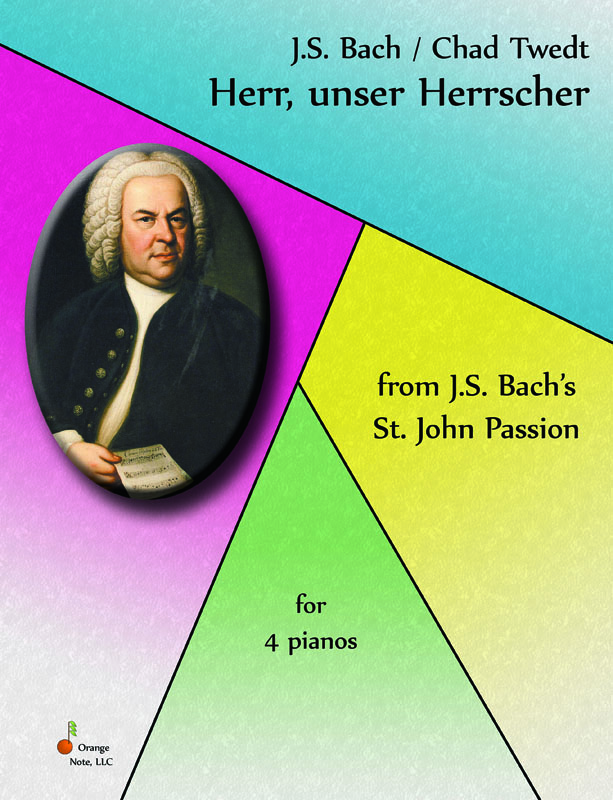
I’m proud to announce my most recent music publication: a four-piano arrangement of the opening chorus (“Herr, unser Herrscher”) of St. John’s Passion, available at Orange Note. A high-quality computer rendering of the full work can be heard there. The work was commissioned in 2025 by Piano 4te, the same group who commissioned my four-piano original work, Cosmosis. Piano 4te will be performing the world premiere of the work in December 2026 in Pittsburgh, PA.
This chorus is my favorite of all of Bach’s choral works, and it has been a decades-long desire of mine to produce a piano ensemble version of this music. It is a monstrous, 10-minute long piece of intensely passionate music. The piece quickly dispels of any notion that Bach writes his music in a purely cerebral way, void of any emotion or passion – a notion that I can’t entirely blame intermediate piano students for having when their primary exposure to Bach consists of inventions and sinfonias. In fact, I can’t think of any other piece of music that has more emotion packed into it.
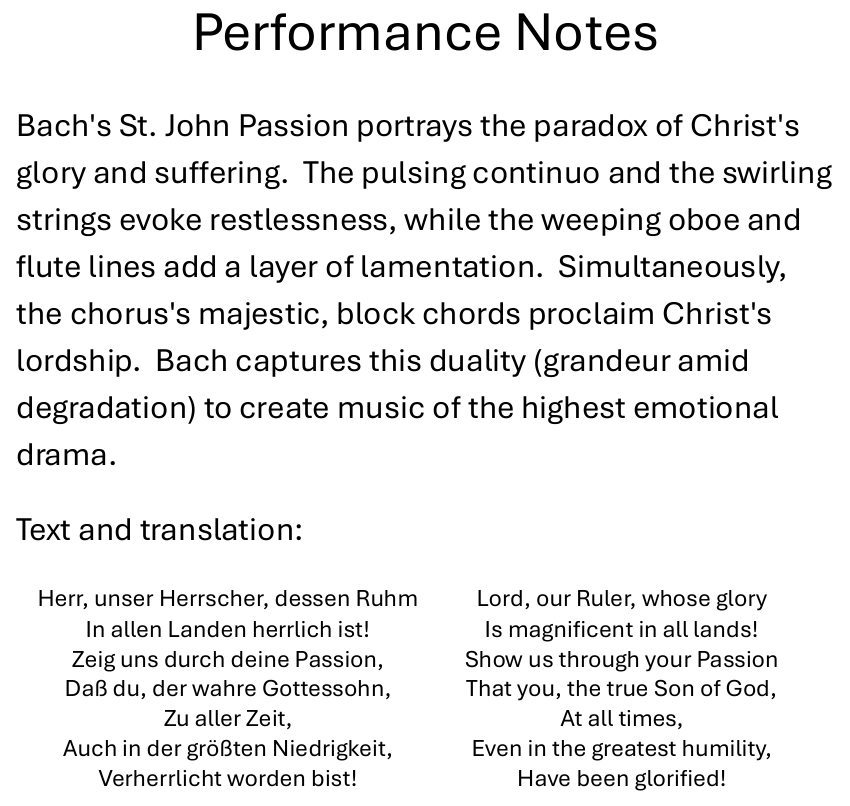
An excerpt of what I wrote in the sheet music Performance Notes:
Years ago, I had initially started writing a two-piano version of this, but even with two pianos and 20 fingers at my disposal, I still felt that big sacrifices needed to be made; even two pianists could not play literally everything that Bach put into this work. Nonetheless, this issue was workable – most sacrifices wouldn’t be terribly missed.
But compounding on top of this problem was what I previously felt was an even bigger problem: what to do about the long-sustaining notes played by the oboe and flute. The first minute or so of the original work (before the chorus comes in) features some incredibly beautiful dissonances (suspensions) created by very long-sustaining notes. Simply transcribing these long notes exactly as Bach wrote them, especially in the upper register of the piano, becomes a joke. The piano’s sound is produced with hammers that strike strings, and because of that, the piano is forever doomed to the reality of decaying tones. Before a listener is able to perceive the beautiful suspensions Bach wrote, the warp-speed decay of the piano’s upper register wipes these long-sustaining notes out nearly entirely, negating the heart and soul of Bach’s emotional drama. This was a big enough problem that it caused total demotivation on my part to continue the project. “If Bach wanted this to be played on piano, he would have written it for piano,” I justified to myself painfully.
When I was asked to write another work for Piano 4te, for some reason, I decided to revisit this issue, and try out a solution that I had dismissed a thousand times before: simulating the sustaining quality of the woodwinds via measured tremolos and repeated notes. I had previously thought this would be an obnoxious effect not even worthy of pursuing, but once I gave the technique a fair chance, I was more than pleasantly surprised at how quickly the listener “normalizes” the effect throughout the piece, even when these notes are played fairly prominently. “Solving” the problem by always playing those notes softer than everything else doesn’t solve the problem, because sometimes these voices are the only thing going on in the music – fortunately, it turns out it’s OK for this effect to be prominently present.
The work follows an A-B-A structure, but when section A returns, I give it a fuller texture (more notes/octaves), and I take some liberty to give it a different dynamic plan.
In the end, this four-piano arrangement represents not just a transcription, but a heartfelt dialogue with Bach’s masterpiece—one that honors his unparalleled emotional intensity while embracing the piano’s unique voice. By expanding to four instruments, I’ve aimed to preserve nearly every layer of his rich contrapuntal tapestry, allowing those profound suspensions and majestic proclamations to resonate fully in a new medium. I’m deeply grateful to Piano 4te for inspiring this revival of a long-dormant dream, and I can’t wait for audiences to experience the dramatic power of this music when they bring it to life in the world premiere next December. If Bach’s “Herr, unser Herrscher” has ever moved you, I hope this version will capture that same grandeur amid degradation, restlessness amid lamentation, in a way that feels both faithful and freshly alive.