Not to be confused with the layman’s understanding of a “festival,” a piano festival is not some kind of extravaganza piano sales event with balloons, parades, and food trucks. In the world of music education, a “festival” is a performance event for students with higher stakes than a recital (it is judged), but lower stakes than a competition: the participants are only judged against themselves and are each assigned individual ratings based on their performance.
Our Reno festival began in 1967 with three teacher-judges (never judging their own students), five possible ratings (Superior, Excellent, Good, Fair, Poor), and majority rule. Superior was meaningful because it required broad agreement. There was (and still is) an additional highly-coveted rating, the Superior With Distinction, which is a “knock your socks off performance” that has to be awarded unanimously among all three judges. Students receiving Superior and above get to play in a gloriously climactic Command Performance on Thursday the next week, performing the one favorite piece selected by the judges and receiving a trophy immediately after each performance. Superior students in the two most advanced levels got medals put around their necks after their performances, as if they were Piano Olympic medalists.
The event was hugely motivating for me, fueling practicing throughout my younger formative years. I also experienced the festival as a teacher from 1997 to 2012, up until we moved to Pittsburgh, PA for seven years. We moved back to Reno in 2019, and I found that gradeflation had taken hold of the festival.
Feedback is Critical for Growth
As a young student, the Superior seemed genuinely difficult to achieve, even when I practiced every day to prepare for the performance. I remember on some occasions seeing more students in a session getting Excellent than Superior. One year, probably around 5th or 6th grade, I got an Excellent in our local festival. I will never forget how much that Excellent motivated me to work harder the next year. In all years after getting that Excellent, my objective was to prepare so well that even if I had an “off” day and stumbled a bit, I still got a Superior.
Later, as a brand new teacher in the late 1990s, my goal was to prepare my students so well that 100% of them got Superior ratings. At first, I was pretty close to this goal; around 98% or 99% of my students got Superior ratings, which was something I was proud of given that between 65% and 80% of students got Superior ratings from year to year. After five or so years of this, achieving Superiors felt somewhat easy, so my goal then became “try to make a Superior With Distinction possible for all students.” By the mid or late 2000s, between two and five of my students every year would get a Distinction rating.
In other words, at all points of my musical development, both as a student and as a teacher, the festival both motivated and facilitated my growth, because it was the highest stakes feedback I received all year long.
In festivals, the rating acts as the frame around every comment on the page. “This was a Superior, but…” allows a student (and parent) to dismiss anything after the “but.” “This was an Excellent, and here’s why…” acts like a bright yellow highlighter for everything that follows. No amount of contradictory words on the page can undo the psychological power and virtue of the truthful, accurate rating itself. But in our festival today, gradeflation (near-universal Superiors) have undermined that motivation.
How False Feedback Harms Everyone
Some teachers believe they are being professional or encouraging by inflating ratings to protect feelings. These words are euphemisms for dishonest. It prioritizes short-term student retention over a student’s long-term ability to understand their own skills. Worse, “tell me I’m better than I am, or I will quit piano lessons” is not only emotional blackmail, it’s a false premise. In decades of teaching, I have never seen this come even remotely close to happening, but I have seen (countless times!) a disappointing rating cause more motivated practicing the next year, including my own example above. If a student were to quit over one rating, that would reveal a truly toxic attitude that should have been addressed long before the festival. And certainly, an attitude like that should not serve as any foundation whatsoever on which to build an entire festival.
False feedback also sets deluded students (and their parents) up for painful awakenings. I’ll never forget talking to a college peer music major decades ago as an undergraduate music major – on several occasions, they complained with great passion about a previous teacher who led them to believe they were a well-polished pianist when in fact they were far from it, as they so painfully discovered when they did not receive a music scholarship. A professional will find kind, genuine ways to compliment and encourage students over years of study, but ultimately, students and their parents desperately need and want the truth. Nothing obscures truth on an adjudication sheet more than a false rating.
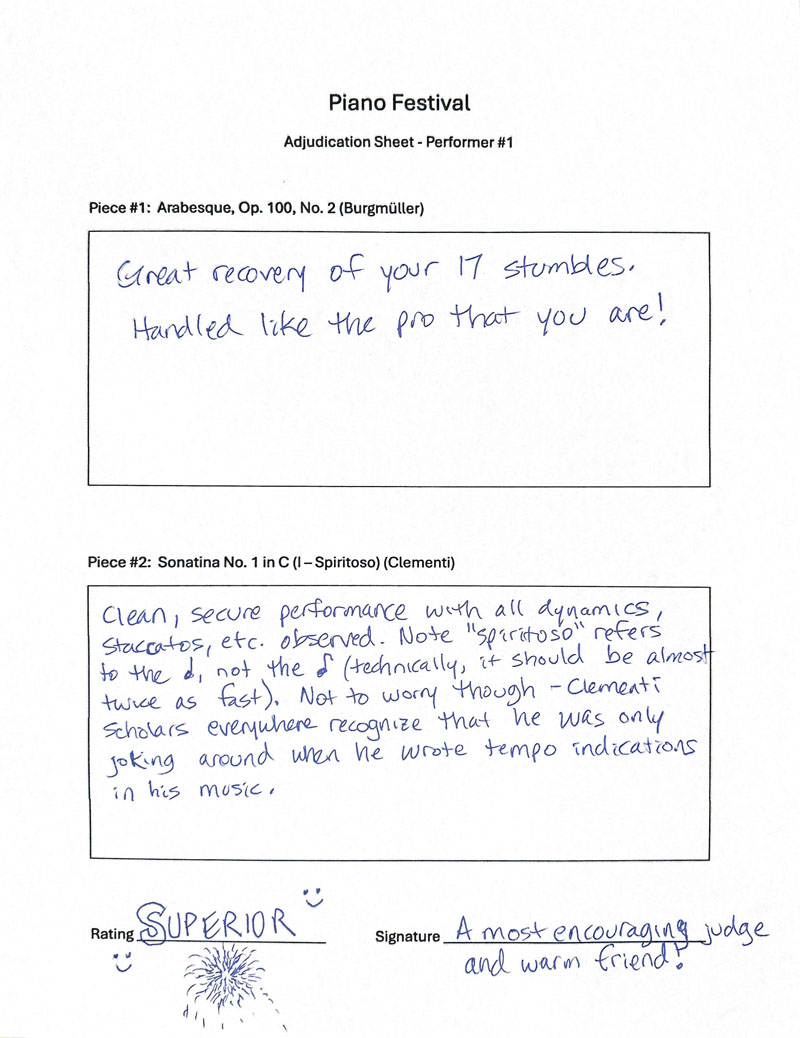
There is also honor and glory in earning a well-deserved Superior. I’d argue this is even the most important aspect of the festival. All truly worthwhile endeavors involve risk, and without risk, the glory is empty and mundane. When a student who played really well ends up getting the same Superior rating as another student who stumbled many times in one piece and played their other piece so slow that it might as well be called a “practice tempo” (see image to the right), it treats the gap between the two students as negligible or non-existent, when in fact it is quite noticeable (sometimes cumulative hours of practice on one piece alone). What does the Superior mean to those who worked for a high standard when those who work half as hard are given the same award?
False feedback undermines teachers as well. Over the decades, numerous teachers in my own association have said that sometimes one of their students goes into the festival not having addressed certain goals given to them, for whatever reason (lack of practice, inefficient practice, or heaven forbid, conscious dismissal of the importance of the teacher’s goals). The student performs at an Excellent level of playing, and the student is delivered a Superior rating. I’ve known several teachers to be explicitly frustrated by these situations, as it sends students the clear message that the teacher’s standards are optional.
Inflated ratings also reward teachers who push young students into inappropriately advanced repertoire to impress parents of their students (and to impress students/parents of other teachers). This fragile progress, resulting from what I call peacock teaching, becomes more and more evident as the student progresses into more demanding repertoire. By no coincidence, when these students progress into advanced levels of playing, their teacher assigns them almost exclusively slow tempo pieces with lots of pedal so that their increasingly severe lack of technical facility / finger dexterity is hidden from view.
Gentle honesty (and joking around!) has always been my studio philosophy; I have always believed there is a kind way to deliver the truth to students. But during all these years of teaching under that philosophy, a “philosophical” question has always loomed in the back of my mind: To what degree is “asking students to do what is marked in the music, and telling them when they’re not doing it” really a teaching philosophy? It occurs to me that having students do what is marked in the music (and avoiding assigning pieces students are not equipped to understand and/or play) is just regular old teaching, rather than some kind of philosophical subcategory of teaching. But regardless, when the honesty pendulum is swung in the other direction such that it values feelings over truth, this definitely feels like an actual teaching philosophy. Why does this distinction matter?
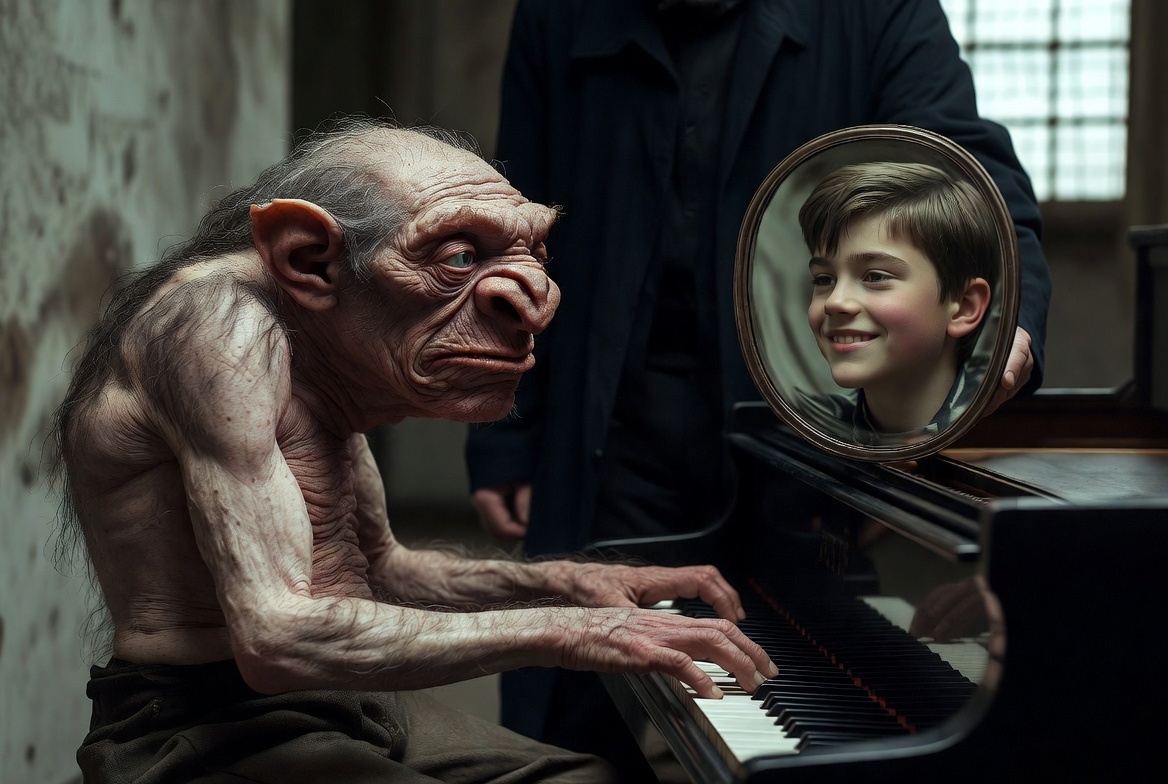
When a festival prioritizes honesty and truth, there is no imposition onto anyone, because no philosophy is present – the festival acts as a neutral (but still kind) messenger of truth and honesty. But when the philosophy of prioritizing feelings over truth (or any “philosophy” at all) is embedded systemically into an entire piano performance event, this philosophy is imposed onto teachers. Does a flat mirror that reflects reality impose a body image “philosophy” onto the person looking into the mirror, or is it the curved mirror that does that?
How Systemic Changes Created Our Problem
In our festival today, judges are now hired from out of town, which is fine, although I personally think money spent on out-of-town judges is not even close to worth it when there are, in even smaller local areas, multiple teachers who can deliver competent feedback in festivals and who don’t have any students entered in the festival.
The available ratings have shrunk to just 3 choices: Superior, Excellent, and Needs Attention, which is also fine, since the “Fair” and “Good” ratings were almost never used anyway.
What is not so fine is the fact that sessions use only two judges combined with the fact that ratings still “round up.” That means a student earns a Superior if only 50% of the judges believe it is a Superior, as opposed to previously needing a 66.7% majority. The predictable result is that 99–100% of participants have been awarded Superiors in recent years, compared to the historical 65–80%. As in every festival I’ve ever heard of including our own, judges are already told to “err on the side of generosity when torn between two ratings,” which in my opinion is already plenty of generosity to hedge against the dreaded “the judges ripped me off” rating.
There is also a phrase that made its way into the festival, eventually being explicitly read to adjudicators during their orientations: “The festival was originally designed so that an average hard-working student can get a Superior rating.” While perfectly true, I believe that some judges hear this statement and think, “An average performance should be a Superior,” when in fact the statement only says that if an average student prepares really diligently for the event, a Superior is possible. Statements like this should simply be omitted.
When I directed the festival in 2026, I saw the results firsthand: nearly every session produced 100% Superiors (98% Superiors in the lower levels, and literally 100% Superiors in the upper levels). Students who knew their performances had issues looked visibly surprised when told everyone received Superior. Truth would not have shocked the 10-12 students who should have received Excellent ratings, and that is the norm. I still saw the same small number of true Distinction-level performances—sometimes more—proving that, statistically speaking, there are still just as many diamonds in the rough as there ever were. The new generation of young pianists is not less capable of achieving musical greatness than any generation before them, and their results prove it. The playing hasn’t changed; the judging has. The unwillingness to tolerate occasional undeserved Excellents comes from teachers, not students.
Detection Theory: The Right Framework for Festivals
Imagine designing a system to detect nuclear missiles approaching the West Coast. Set the threshold too low and you blow up seagulls (false positives). Set it too high and a real missile gets through (false negative). No rational system accepts a nuclear catastrophe in order to avoid exploding birds. This is the essence of detection theory.
A piano festival is a detection system. It tries to distinguish Superior performances from Excellent ones. Many organizations treat the rare false Excellent (awarding Excellent to a Superior performance) like a nuclear holocaust while treating massive numbers of false Superiors as harmless. This is a profound misapplication of detection theory. As discussed in a Read Twedt article I recently published (A Lens Inspired By Detection Theory), there is no detection system conceivable that will both protect against false Superiors and false Excellents with an error rate of zero. Effort must be made to balance them with the understanding that no conceivable solution will be perfect.
The current two-judge, round-up system guarantees the wrong outcome at a massive scale. One of two simple fixes would restore integrity: (1) require two judges to have unanimous agreement for the Superior rating, or (2) have three judges with “majority rule.” Also, when giving orientations to adjudicators, stick to the objectivity of going over ratings criteria, and avoid trying to describe the kind of student the festival was designed for.
Literature on music education, feedback, and motivation strongly favors honest, constructive ratings over generous or borderline dishonest ones. No credible studies advocate inflating scores in piano festivals to “encourage” continuation. Instead, research such as this highlights the value of accurate feedback for building genuine motivation, resilience, and long-term retention.
Festivals should function like a flat, honest mirror, not a flattering, distorted one.
(c) 2026 Read Twedt